Friday, August 03, 2007

ALPINE GOLF & SPORT CLUB


ALPINE GOLF & SPORT CLUB


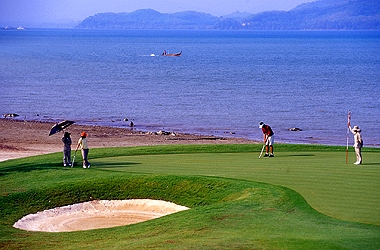
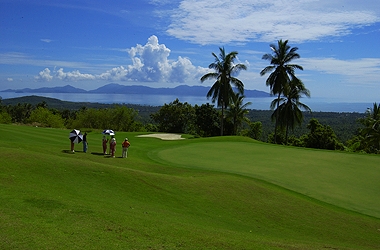
ALPINE GOLF & SPORT CLUBWelcome to the Alpine Golf Club - and a world of the ultimate in golf. A masterpiece course spread out over 180 acres of prime land, located only 30 kilometers northeast of Bangkok, its layout measures 7,100 yards and plays to a par of 72. With its undulating greens and fairways and strategically placed hazards, the Alpine experience will challenge you to play your very best. Precision swings are required to achieve the peak of perfection - all at the Alpine. Alpine Golf Club is a private club that offers the full range of services tailor-made to the discerning golfer who is looking for a true championship course test, and all the top-class personal comforts that go with it.


HEALING RISHI SPA


HEALING RISHI SPA


89 Moo 7 Barn Sirsahakorn Sansai Nongjom Chiang Mai 50210 Tel.+6653 844828 Fax: - Contact Us /td>


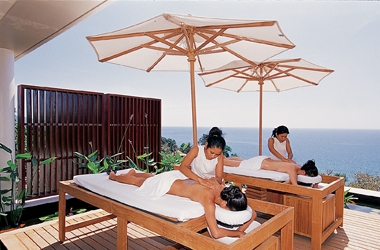
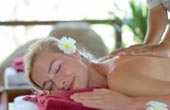
HEALING RISHI SPAOver two thousand years ago, the Healing Rishi Shivaka offered a powerful form of healing to Lord Buddha and his students. His style of healing has been used by the Thai Temples and villages ever since. The Healing Rishi Spa has researched this ancient form of healing and created a special program of Spa Treatments, Thai Massage, Thai Rishi Yoga and deep meditation to soothe body, mind and soul. We have created a spa that provides an authentic experience of Thai life as the Thai people have enjoyed it for thousands of years. Our architecture and grounds are done in Thai Temple and village style surrounded by the lush tropical environment of fragrant trees and flowers typical to Thai life. Rice fields and a beautiful view of the mountains surround our spa, even though we are located only a few minutes from downtown. The Healing Rishi Spa is dedicated to offering you the real experience of Thailand and will always take care of you with a genuinely warm Thai smile and hospitality. All of our spa treatments are prepared from fresh herbs and fruit grown in our gardens and picked daily for each session in the same manner as it has been done for thousands of years. The extraordinary warmth of the Thai people has its roots in a culture that is deeply connected to Nature. We are not a cosmetic international spa. We are an authentic Thai spa that offers only the best that Nature can provide. Our Temple style buildings are luxurious inside with everything designed for your comfort and serenity.

Wednesday, July 25, 2007

Hotel Thapwarin Resort *** Krabi, Thailand


Hotel Thapwarin Resort *** Krabi, Thailand


Welcome to Thawarin ResortA truly Natural resort feeling at Thapwarin,we truly believe in eco-tourism and the philosophy of living in harmony with nature and is committed to preserving the natural beauty of the island for tourist like you to enjoy and appreciate,Hence the use of mostly natural materials like wood, bamboo,rattan and attap to construct the resort Contact us:140/2 Rongrien Rd.,Muang,Trang,Thailand 92000Office:075-218 153,075-218 261 Office fax:075-218 153 Resort:083-105 8273,081-894 3585,075-203 169 Resort fax:075-203 169 e-mail:sale@thapwarin.com website: http://www.thapwarin.com/
Rooms Rates 01 November 2006 - 31 October 2007
Rooms Type
High Season01Nov-31 May
Peak Season20 Dec-15 May
Low Season01 Jun-31 Oct
Beach Villa(A/C+Hot Shower+Mini Bar)
4,500 Baht
4,900 Baht
3,000 Baht
Beach Front Cottage(A/C+Hot Shower)
3,900 Baht
4,300 Baht
2,600 Baht
Sea View Cottage(FAN+Hot Shower)
2,200 Baht
2,500 Baht
1,500 Baht
Garden Cottage(Fan+Hot Shower)
1,800 Baht
2,100 Baht
1,200 Baht
Extra Bed(with Breakfast)
600 Baht
600 Baht
500 Baht
All rates quoted are in Thai Bath. Applicable to Single & Double Occupancy and inclusive of breakfast (Good for two persons only), 10% service charge & VAT.No charge for children under 12 years old and staying with parents without an addtional bed. Child under 3 year of age tree charge for breakfast but child 4 to 12 years of age will be charge 150 Bath.
Transfer: The resort can provide van and boat from and to the resort. For transfer rates please see lieted below.
From Trang airport/ Trang town to Pakmeng pier to resort 600 Bath per person/ one way/ Van and Speed boat (èjoin).

Bangkok Wonderous and Woeful

Bangkok Wonderous and Woeful


By John HoskinBangkok is not a beautiful city. But it is unquestionably a captivating one, exerting an irresistible charm as the epitome of all things Thai.Alec Waugh got it right in his 1970 book on the Thai capital: "Bangkok has been loved," he wrote, "because it is an expression of the Thais themselves, of their lightheartedness, their love of beauty, their reverence for tradition, their sense of freedom, their extravagance, their devotion to their creed -- to characteristics that are constant and continuing in themselves."

The characteristics seem contradictory, but Bangkok is a huge paradox, at once wondrous and woeful. For this it is one of the world's most distinctive cities, a place that fascinates by making innumerable contradictions seem consistent. It is at once chaotic and serene, ancient and modern, sacred and profane, pandering to nouveau riche greed and proudly caring of traditional values... the oddities are as endless as they are real.
Real Time Booking on Bangkok Hotels
All prices include breakfast.
Menam Riverside

Landmark Hotel
91 $
Baiyoke Sky
51 $
Asia Hotel
42 $
Novotel Lotus
60 $
Swiss Park
33 $
Rembrandt
62 $
Royal Park View
35 $
Hilton (Nai Lert)
97 $
Montien Riverside
69 $
Arnoma
61 $
Century Park
61 $
The Grand Hotel (old Nikko)
42 $
Royal Orchid Sheraton
137 $
Zenith
44 $
Hyatt Erawan
171 $
Intercontinental
192 $
JW Marriott
152 $
Sheraton Sukhumvit
154 $
Peninsula
185 $


The key to understanding Bangkok is to realize that beneath its modern facade it remains unmistakably Thai, traditional and essentially unchanging. Ultimately, the city is simply itself and you have to accept it as such if you are ever going to come to terms with it. The horrendous traffic congestion is perhaps everyone's biggest complaint, but even for those who complain, cars in Thailand are not firstly a means of transport, they are social cachets which once obtained are not to be relinquished lightly.
Traffic congestion is part and parcel of the Bangkok experience, and it is easier to accept when you realize it is not going to change. Nor is it new. There never were any halcyon days before the canals were filled in to make way for paved roads. Here's Queen Victoria's envoy Sir John Bowring on the hazards of Bangkok's then waterborne traffic: "Boats often run against one another, and those within them are submerged in the water...The constant occurrence of petty disasters seems to reconcile everybody to their consequences." That was in the 1850s but the idea of being reconciled to the inevitable hassles of city traffic remains true today.More

The Thai Temples


The Thai Temples


You can't please all of the people all of the time; some people never. Thai temples are magnificent buildings, testaments to both an enduring faith and to centuries of cultural endeavour.But they are highly distinctive and you need to meet them halfway for a full appreciation.
Some people fail to take the correct approach and hence miss the true attraction. English writer Geoffrey Gorer is a case in point.

His otherwise forgettable 1936 travel book Bali and Angkor is remarkable for his displeasure with Thailand. "It is very difficult to take Bangkok quite seriously; it is the most hokum place I have ever seen, never having been to California," Gorer wrote. Prompting his sneers was Thai traditional temple architecture, which he thought "the same as Cambodian, but with knobs on -- lots of knobs."
It seemed to Gorer that "wherever a bit of decoration or twirly-whirly can be fixed with some possibility of its staying put it is stuck on." The elaborate adornment of Bangkok's Wat Arun finally proved too much. Gorer repeats a guidebook suggestion that the temple is best seen for a distance and adds, "Yes, indeed. You can't be too far away from these buildings to get the best effect."


On this showing Gorer would clearly have a thing or two to tell St Peter about Heaven's Gate. His criticisms are misplaced, however, and he uses a mundane yardstick for assessing what is the truly fabulous. Ironically it was a writer of more famous acerbity, Somerset Maugham, who perceived and accepted the real wonder of the Thai temple.
"They are unlike anything in the world, so that you are taken aback, and you cannot fit them into a scheme of the things you know," he wrote in 1930. "It makes you laugh with delight to think that anything so fantastic could exist on this sombre earth. They are gorgeous; they glitter with gold and whitewash, yet are not garish; against that vivid sky, in that dazzling sunlight, they hold their own, defying the brilliancy of nature and supplementing it with the ingenuity and playful boldness of man."
Maugham captures the delight that nearly all visitors to Bangkok find in the city's temples. They are rightly at the top of anyone's sightseeing list. The immediate attraction lies, as Maugham so vividly portrays, in their fabulous appearance, their exotic architecture, their wealth of decorative detail.
Yet there is more than just the initial visual impact, and a closer look at Buddhist temples opens up a whole world of understanding about Thai society and its art and culture.
Buddhism, along with the tradition of monarchy, underpins the nation's entire cultural and social fabric. It is the religion under which the people (originally animists) were first united, and it has remained a vital and visible force in daily life throughout the more than 700 years of Thai history. Today it is as strong as ever, practised and professed by more than nine-tenths of the population.
Quintessential to the religion is the monkhood. Central to Buddhist practice is the concept of making merit and the supreme form of merit, for men at least, is to become, if only temporarily, a monk. Even in modern Thailand most young men will still comply with this custom, becoming ordained and entering a monastery for a period of perhaps one, two or three months.
Women and the population at large make important merit by giving daily food offerings to monks. At any one time, present-day Thailand supports a religious community of some 250,000 monks who reside at an estimated 27,000 temples throughout the country.
The concept of merit-making and the various ways in which it may be achieved, as well as the deeper meaning and practice of Buddhism and its attendant monkhood, need not concern us here. What is important to grasp for an appreciation of the Thai temple is the integral role of the religious community and hence the material structure which supports it.The word "temple" is largely unsatisfactory as a translation of the Thai word wat. It implies a single structure, as is the case with a Christian church, but this is not so with a Buddhist wat. Besides monks' residential quarters which are commonly, though not always, found at a wat, a Thai temple complex comprises several distinct religious buildings.
The principal structure is the bot, the most sacred part of the temple and the place where ordination ceremonies are conducted. The building is identified by eight boundary stones, called sima, placed outside at the four corners and the four cardinal points. More.

Exploring Thai Towns on Mekong


Exploring Thai Towns on Mekong


By John HoskinChiang Rai hides its age well. It is, in fact, thirty-five years older than Chiang Mai, northern Thailand's largest and best known city. Founded in 1262, it was briefly the capital of King Mengrai's budding Lanna kingdom, but history passed it by when, in 1297, Chiang Mai was created as the North's permanent capital.

The world's 12th longest, 10th largest river, the Mekong rises in the Tanghla mountains of northwest China and flows through the heart of peninsula Southeast Asia before reaching the sea at the southernmost tip of Vietnam


Nowhere along its 4,200-kilometre course does it enter Thailand, although much of its middle passages skirts the Kingdom, forming the national boundary with Laos. The river touches Thailand briefly in the far north, but it is much more extensively viewed in the northeast where its passage provides the focal point for a fascinating tour of the region's riverine towns.
For the people of I-san, as northeast Thailand is known, as well as for their ethnic cousins, the Laotians, the Mekong plays a traditional and integral role in their lives, dependent as they are on wet rice cultivation and fishing for their food staples. The river also figures large in legends, popular beliefs and folk culture, all of which adds colour and interest as the traveller passes through stunning scenery in a landscape mostly untouched by modern development.


The most convenient gateways to the Mekong in I-san are the provincial centres of Loei, Nongkhai or Ubon Ratchathani. Road from Bangkok provides the easiest access, although Ubon is served by domestic THAI flights, while both Ubon and Nongkhai can be reached by rail from Bangkok. Once in the region, travel by car is easiest; alternatively public buses link the main towns.
For touring purposes, a journey starting in Loei and finishing in Ubon, or vice versa, covers the Mekong's entire passage in the northeast, with a road bordering the river for most of the distance. A shortened excursion takes Nongkhai as the starting point.
The Mekong first joins the Thai border in I-san a short distance to the east of the small town of Chiang Khan, lying about 50 km due north of Loei. Set in a large valley surrounded by wooded hills, Chiang Khan is a typical riverine settlement in these parts; lost in its own tranquility and remarkable purely for its pretty setting and fine views of the river.
From Chiang Khan a road parallels the river on its eastward passage towards Nongkhai. A short distance downstream of the town are the Kaeng Khut Khu rapids, where the Mekong makes a sharp curve to pass a rocky outcrop. Apart from scenic spots such as this, the route along the riverbanks remains consistently picturesque, the forested hills of Loei reflected across the valley in the even more verdant mountains of Laos.
Dotting the surface of the water are small islands and sandbanks many of which, like other natural features along the Mekong, are associated with local legends. Two islands near Pak Chom, for example, represent, so one tale has it, a Thai man and a Laotian woman who were deeply in love, but their union was thwarted by insurmountable obstacles that eventually led to their deaths.
True tales, too, exemplify the mythical status attributed to the river by popular belief. On both sides of the Mekong people talk of how the river can become "hungry" for a human soul, and how, if not appeased, the rains will not come and so the rice crop will fail. Such beliefs are not idly held.More


Monday, June 11, 2007

EVASON PHUKET RACEWEEK 2007


EVASON PHUKET RACEWEEK 2007


Asia’s fastest-growing regatta July 19th – 22nd 2007


The Evason Phuket Raceweek 2007, now in its fourth year, will take place on the beautiful waters off the Rawai Beach on the South Eastern side of Phuket Island.With the promise of international-standard yachting and five-star parties, the Regatta will play host to over 40 boats and 300 participants. Evason Phuket Raceweek is the fastest-growing regatta in Asia; the event creates the perfect opportunity to relax, network and entertain.This year’s Raceweek comprises a four-day regatta covering seven race classes. While the final composition will be determined shortly before the event, likely classes include Racing Sports Boat Class, IRC Class, Club Class, Multihull Racing Class, Multihull Performance Cruising Class, Firefly 850 One-design Class and Classic Class.The lower sea view terrace of the Evason Phuket Resort and Six Senses Spa will operate as the Phuket Raceweek HQ. The resort is the sponsoring host venue for the fourth year running, and is set among 64 acres of beautifully landscaped tropical gardens. Meanwhile, all the look-out points on the South Eastern side of Phuket Island will provide spectacular vantage points for the action.Evason Phuket Raceweek is held under the auspices of the Ao Chalong Yacht Club, in conjunction with the Yacht Racing Association of Thailand. Organisers Image Asia Events Co., Ltd. will draw upon their vast experience with the Phuket King’s Cup Regatta, and the Phuket International Marine Expo (PIMEX) to create an event that perfectly showcases the region, and the sport.Image Asia Managing Director Grenville Fordham said: “We are really excited to be organising the 4th EvasonPhuket Raceweek. The 2007 event will undoubtedly be the best yet. It is rapidly becoming a big draw for spectators and participants alike, so such a prestigious event is very important for the local area and economy.”English commercial sponsorship & partnership marketing opportunities executive summary attached. For aThai version, please contact Thanthip Kaewsri on +66 8 1694 7412 or thanthip@email.comFull details can be found at: www.paulpoole.co.th/phuketraceweek and http://www.phuketraceweek.com/ and http://www.image-asia.com/


The Phuket International Marathon 2007


The Phuket International Marathon 2007

the largest destination marathon in South East Asia, will take place on Sunday 17th June 2007


Only in its sophomore year, the Phuket International Marathon 2007 looks set to build substantially upon the success of last year’s inaugural event. Organisers Go Adventure Asia are expecting a 100 per cent increase in participants – including 1,500 international runners from 40 different countries – which will provide a global platform for the beautiful Thai region. The date of the event was specifically chosen to maximise the benefits of the event for the island. Held during a traditional low-season the, Phuket International Marathon 2007 will encourage the tourist industry to thrive throughout a typically quiet period.
The focus of the event is not on breaking world records but in establishing a respected competition that exposes the true beauty of Phuket. Following the Tsunami disaster in 2004, the organisers set out to create an event that celebrated how the people, businesses, and landscape of Thailand had recovered and were moving forward.In 2007, Go Adventure Asia is encouraging runners to raise money for a charity of their choice. This is a new concept in Thailand, but the organisers hope to emulate the success of the London Marathon, whose 9500 participants raised in excess of £12 million in 2006. The Phuket International Marathon 2007 has nominated HOPE worldwide (Thailand) as its official charity. HOPE worldwide (Thailand) is dedicated to helping needy children and underprivileged girls in Thailand.
The race course navigates around the picturesque Northern part of the island, allowing people of all abilities to participate whilst still enjoying the stunning scenery of the island. A Half Marathon and a 10km Fun Run have been organised in addition to the Marathon – making this incredible sporting experience available to people of all ages and athleticism.RUN PARADISE!The Phuket InternationalMarathon, 2007June 15th – 17th 2007
PHUKET INTERNATIONAL MARATHON 2007 SCHEDULE OF EVENTS • Friday June 15th – Expo – Participants pick up Race-Kit’s @Laguna Beach Resort • Saturday June 16th – Expo – Participants pick up Race-Kit’s @Laguna Beach Resort • Saturday June 16th – Pasta Party @ Similian Ball Room, Laguna Beach Resort • Sunday June 17th – 2nd Phuket International Marathon • 05.00hrs - Start of Marathon • 06.00hrs - Start of Half Marathon • 06.30hrs - Start of 10k Fun Run • 08.00hrs - Start 5k walk • 09.00hrs - Start 1k Kids Run • 09.30hrs - Winner’s Presentation • 10.00hrs - Cultural Performances on stage • Sunday June 17th – Farewell Party @ Columbian Garden, Dusit Laguna Resort Marketing Support by Paul Poole (So uth East Asia) Company Limited
A ‘Pasta Party’ on the evening of the 16th and a Farewell Party on the 17th provide an excellent opportunity to meet fellow runners, organisers, and taste some of the delicious seafood from the Andaman region. Entertainment will be provided by traditional musicians so participants can taste both the delicacies and culture of the island – before exploring the geography during the race. Tickets can be bought online or at the event Expo on the 15th and 16th June.
“2007 will be an excellent year for the Marathon” commented Raimund Wellenhofer – Phuket International Marathon 2007 race director - “The professional organisation of the inaugural event was commended – but for 2007 the race has grown significantly in size, and as such, we hope to offer sporting excellence while providing even greater exposure for the region’s beauty and abilities.”More Information: http://www.phuketmarathon.com/ www.purpletangerine.com/phuketmarathon
http://www.goadventureasia.com/ http://www.thailandmarathon.org/ http://www.hopeww.org/

Friday, January 26, 2007

The Jazz Giants Salute H.M. The King’s 80th Birthday Concert


The Jazz Giants Salute H.M. The King’s 80th Birthday Concert
This is a rare opportunity for Thai Jazz fans to meet four world class jazz musicians who will perform in a one time only concert “The Jazz Giants Salute H.M. The King’s 80th Birthday Concert” to celebrate H.M. King Bhumibol’s 80th Birthday


The Jazz musicians are Sal Cracchiolo, an accomplished trumpet player. Sam Most, one of the first great jazz flutists, a cool-toned tenor, and a fine clarinetist. Richard Simon left a comfortable position as a college English instructor to pursue the perilous life of a jazz bassist. Urbie Green, a free-lance trombonist . He is a smooth, warm and mellow trombonist.
The 4 world class jazz musicians will play eight of the King’s composed songs, which had been rearranged for this special occasion, with Big Band, in Maynard Ferguson Style and Small Group, in Benny Goodman Style along with ten other jazz musicians.
“The Jazz Giants Salute H.M. The King’s 80th Birthday Concert” will be one and only performance on Monday January 29 (7.30 pm) at Thailand Cultural Center, ticket cost 800 / 1,200 / 1,500 / 2,000 / 2,500 baht, available at Thai Ticket Master Tel. 0 2262 3456 or
www.thaiticketmaster.com
More information, please contactMystery Co.,Ltd.Pakpicha Satachanan Mobile 08 6330 9185

The 2nd Annual Phuket International Blues Festival


The 2nd Annual Phuket International Blues FestivalDate 16 Feb 2007 - 17 Feb 2007 Following the success of the 1st Phuket International Blue Festival, Phuket Music Production Company, Ltd. announces The 2nd Annual Phuket International Blues Festival.

The 2nd Annual Phuket International Blues Festival Date 16 Feb 2007 - 17 Feb 2007 Following the success of the 1st Phuket International Blue Festival, Phuket Music Production Company, Ltd. announces The 2nd Annual Phuket International Blues Festival. Place The 2nd Annual Phuket International Blues Festival will be held the third weekend in February; February 16-17, 2007, at the Hilton Phuket Arcadia Resort and Spa in Karon Beach. Activities The 2nd Annual Phuket International Blues Festival ; February 16-17, 2007,
The schedule is now confirmed. The highly acclaimed Rich Harper Blues Band (U.S.A.) will once again headline the event and close the show Saturday night. The phenomenal voice of British blues legend Victor Brox will again fill the air as Friday night draws to a close. If you did not see these magnificent performers last time, here’s your second chance!
Confirmed are also The Groove Doctors, Blue On Blue, Cannonball, The Blues Machine and Soi Dog Blues Band, as well as Victor Brox’s daughter, Kyla Brox. Don’t miss this young lady, destined to be Britain’s #1 female singer!
Schedule :
Friday February 16, 2007 18:30-19:40: Blue On Blue, Bangkok 20:00-21:10: The Blues Machine, Pattaya 21:30-22:40: Soi Dog Blues Band, Bangkok 23:00-00:10: Victor Brox, U.K.
Saturday February 17, 2007
18:30 - 19:40: Cannonball, Bangkok 20:00 - 21:10: Groove Doctors, Phuket 21:30 - 22:40: Kyla Brox, U.K. 23:00 - 00:10: The Rich Harper Band, U.S.A.
Sunday Februry 18, 2007
21:00: All-star Jam Session (Location TBA) Contact Information Andy Anderson E-mail :
info@phuketbluesfestival.com www.phuketbluesfestival.com

Wednesday, January 10, 2007

The Cha-Am Municipality provides an opportunity for professional


The Cha-Am Municipality provides an opportunity for professional

amateur Photographers to participate in a photo contest. The theme for the contest Is...

The Cha-Am Municipality provides an opportunity for professional and amateur Photographers to participate in a photo contest. The theme for the contest Is...
"Various Views of The Beauty of Cha-Am"
The theme entries are divided into two categories. (All photos must be taken in the Cha-Am Municipality area.) - Tourist attractions and important places - Festivals, traditions or local customs Terms and conditions - Photos can be submitted by individuals or teams. - No limit to the number of photographs. Entrant may submit photographs to either or both categories. - No restriction on photographic equipment used. - Computer enchancement is unacceptable . - All photos have to be identified by title, place, date and time when they were takem. - Any photos which are taken by officers, teachers or employees of the Cha-Am Municipality are not acceptable.
Conditions entry - photos must be 10 x 123 inches. - Photos taken with a film based camera must have the original film enclosed. - Photos taken with a digital camera must have the photo on a CD enclosed. - Name your photo and enclose your address and phone number for return contact. How to submit photos - send them or post them to the Division of Technical Service and Planning office of Cha-Am Municipality, Naratip Road, Cha-Am, Phetchaburi 76120 and write "photo Contest" in brackets on the bottom right corner.
Entry Deadline 30th June 2007
Contest Prizes for both categories The Grand Prize Winner in each categor receives a certificate and ฿ 10,000. The Runner Up Winner in Each category receives a certificate and ฿ 6,000. The Third Place Winner in each category receives a certificate and ฿ 4,000.
All photos will be exhibitioned in the photo exhibition which is going to be held by the Cha-Am Municipality. For further information contact the Division of Technical service and Planning office of Cha-Am Municipality, Tel. 032-471655 or http://www.cha-amcity.com/

Tuesday, December 26, 2006

Travel Thailand: 5 Top Destinations

Travel Thailand: 5 Top Destinations
By Robert Thatcher

With several sights to see and surprises to offer, Thailand could be one of the best locations you should not miss to visit. Culture, beaches, people, and heritage sites are some of the things you can expect when you travel to Thailand.
Bangkok – Traveling Thailand wound not be complete without visiting Bangkok. As the nation’s capital with an estimated population of over 10 million (including the neighboring provinces), this city is by far the largest in the country. The city is divided into 50 districts or khet but for tourists and those who are new in the place, 6 divisions would be more useful. These are Ratchadaphisek in the northeast section of the city, Sukhamvit in the southeast, Silom in the south, Thonburi in the west, Rattanakosin in the central north, and Phahanyothin in the north. The whole Bangkok district would give you a diverse taste of culture, history, religion, modernity, and fast-phase life. You can actually witness how all these blend together to comprise the whole Bangkok package. Buddhist temples, historical museums, towering buildings, contemporary restaurants and hotels, shopping centers, canals and rivers, and food make Bangkok a one of a kind city in Southeast Asia.
Phuket – Down south, Phuket features magnificent beaches, tropical sunsets, white sands, blue seas, and breathtaking sceneries. No wonder it is the most popular vacation destination in Asia beating every beaches of the neighboring countries. It has several beaches like Kata Beach, Karon Beach, Patong Beach, Kamala Beach, and Surin Beach. The island showcases several water sports and activities including parasailing, jet-skiing, and scuba diving. By day, Phuket is alive with beachgoers and shoppers and by night, lights, sounds, and party people dominate the whole island.
Chiang Mai – The second largest city in Thailand with an estimated population of more than 200,000. This city located in the northern part of the country offers greener and quieter city. Chiang Mai’s tourism is becoming more and more popular and permanently settling at this city is very common. When you travel Thailand and visit Chiang Mai, you surely would want to see museums such as Hilltribe Research Institute Museum and the Chiang Mai City Arts & Cultural Center. With religion and history enriching the city, you can see several Buddhist temples such as Wat Chiang Mun, Wat Chiang Mun, Wat Phra Singh, Wat Oo-Mong, Wat Phra Jao Mengrai, Wat Phrathat Doi Suthep, and Wat Chedi Luang. The oldest temple dates back in the 11th century. Chiang Mai features attractions such as Chiang Mai Flower Festival in February, Bo Sang Umbrella & Sankampang Handicrafts Festival in January, The 2nd Orchid Fair also in January, and the Loi Krathong Festival usually falls in November.
Pattaya – Located 150 km. north of Bangkok, Pattaya is one of the most popular tourist destinations, which offers great beaches, beer and go-go bars, and a wide array of sport activities. Visit Pattaya when you travel Thailand is a must. Although it is the most overdeveloped part of the country in terms of tourism, prices in Pattaya still remains with reach. In fact, prices of foods, accommodation, and transportations are very affordable.
Krabi – In a small province of Krabi lies a small town with the same name. Paying a visit Krabi town when you travel Thailand is worth the time. Located south of Bangkok near Phuket and Phi Phi island, the town features great beaches along with high end hotels and not so expensive hotel that cater tourists of different classes.
Robert Thatcher is a freelance publisher based in Cupertino, California. He publishes articles and reports in various ezines and provides Thailand travel resources on http://www.your-thailand-travel.info.
Article Source: http://EzineArticles.com/?expert=Robert_Thatcher

Friday, December 15, 2006

Festival in chiangmai


travel in thailandYi Peng Festival
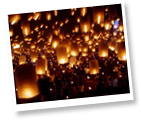
Yi Peng Festival is held annually on Loi Krathong day. It is a very interesting event of Chiang Mai. The festival features launching lanterns into the sky to worship the gods. There are also fireworks, lantern contests, and beauty pageants.


Bo Sang Umbrella Festival
Bo Sang Umbrella Festival is held in January in Bo Sang Handicraft Centre. The festival features paper products, paper parasols in particular, cultural shows, a parade showing traditional ways of life, and several contests.


City Pillar Inthakin Festival
City Pillar Inthakin Festival is held to invoke blessings of peace, happiness and prosperity for the city and its residents. Buddha images are paraded around the city. It is held at Wat Chedi Luang for 7 auspicious days and nights in the 7th lunar month.


Doi Suthep Pilgrimage
On the night of Visakha Bucha Day, worshippers gather to light candles and make the 7-kilometre pilgrimage up to the temple on Doi Suthep.


Flower Festival
Flower Festival is held in February. The festival includes ornamental garden flower contests, floral floats parade in the morning and beauty pageants. The parade begins at Chiang Mai Railway Station and passes Nawarat Bridge and ends at Nong Buak Hat Park.


Songkran Festival
Songkran Festival is held annually from 13 to 15 April. The 13th of April is the Great Songkran day featuring the revered Phra Phutthasihing Buddha image parade around Chiang Mai town for bathing, sand pagoda making, blessing of elders, and water splashing.

Monday, December 11, 2006


PHUKET TO HOST 19th BABA-PERANAKAN CONVENTION
Travel in thailand

Date : AlwayPlace : PhuketThe 19th Baba - Peranakan convention will be held in Phuket, Thailand, during 1-3 December 2006 under ‘the Golden Chain of the Baba Peranakan’ theme. The three-day event will feature a seminar, exhibition, and Peranakan culture show.
Peranakan are local born Chinese descendants whose fathers or ancestors married to local women and settled in the Malay Peninsula which includes Singapore, Indonesia, Malaysia and Thailand, particularly in the south. This community has adapted their cultures and lives in harmony with locals and call themselves ‘Baba – Peranakan’.
The annual event is co-hosted by the Phuket Provincial Administration Organization (PPAO), Thai Peranakan Association and the Tourism Authority of Thailand. Participants will include representatives from brethren associations from Singapore, Malacca, Penang, Kuala Lampur and Thailand.
The PPAO’s Chief Executive Officer Anchalee Vanit Theppabutra said the event aims at promoting their unique culture and provides an opportunity for the Baba – Peranakan communities to foster and share their common heritage.
The PPAO is also working with Satree Phuket School to have student guides lead participants on tours of Phuket city’s cultural routes under Baba – Peranakan Phuket City Tour programmes.
The Baba-Peranakan exhibitionThe Baba-Peranakan exhibition will also be held during November 25 – December 5, 2006 on the 3rd floor of Central Festival. Old photos depicting various aspects of Baba-Peranakan culture and way of life will be on display.
Anchalee further states that the association is now open for new membership to keep the heritage alive.
More information can be obtained at the PPAO’s Education Department tel. 076 217087 or www.phuketcity.org

Contact information: TAT Southern Office – Region 4 Tel: +66 (0) 7621 2213, (0) 7621 1036, (0) 66 7621 7138Fax: +66 (0) 7621 3582E-mail: tatphket@tat.or.th

Thursday, December 07, 2006


Long-stay in Thailand

Linked to the health-and-holiday concept is the promotion of long-stay visitors, with is mainly targeted at getting retirees from countries that have harsh winters and a higher cost of living to stay for extended periods in Thailand, where it is both warmer and less expensive.
Thailand owes much of its international popularity to the remarkable variety of its natural attractions. On offer is a tremendous choice of settings – blissful beaches and islands, rugged hills and jungles, teaming rivers and waterfalls.
Now a related product of this diverse environment, the country's rich natural healing heritage has started to attract a new generation of discerning tourists. With the increasing international popularity of health centred holidays, Thailand is pushing to the fore its world-renowned traditional massage, herbal steam baths, healing arts,
meditation, aromatherapy, yoga, acupuncture, cookery and beauty treatments, as will as an ever-expanding selection of world-class spas. Longer stays are the order of the day as visitors seek not just to experience these healthy ways fleetingly but to absorb maximum benefits over an extended period, while at the same time experiencing the country's history and culture at a deeper level. Once the process of rejuvenation and enlightenment starts to bear fruit, the logic of making this choice becomes beautifully apparent and quite irresistible.
What to do during your long-stay in Thailand

- Enjoy the healthy Thai food and learn the art of Thai cooking
- Enjoy the benefits of traditional Thai massage or learn the techniques for yourself at numerous resorts and spas, as well as the famous Wat Po in Bangkok
- Enjoy traditional Thai healing in the form of a herbal steam bath designed to improve circulation, reduce stress and muscle fatigue, enhance the respiratory system, ease allergies and cure skin ailments.
- Meditate your way to health and happiness.
- Rejuvenate your body, mind and spirit in a distinctively Thai atmosphere at the finest of spas
- Take up yoga and achieve harmony of mine, body and spirit
- Experience the rejuvenating power of the 4,000 -year-old Chinese art of acupuncture, a technique that awakens the body's self-healing responses and restores the balance of yin and yang.
- Experience the holistic healing power of aromatherapy and wave good-bye to negative energies and depression.
- Pamper yourself with all kinds of beauty treatments, modern and traditional, at amazing Thai prices.
- Learn the Thai language for a better understanding of the country and its people, so making your long-stay more fun and meaningful.
Suggested programmes
HEALTH & ADVENTURE
Day 1: By road to Chachoengsao to pay homage to the revered Luang Pho Sothon Buddha image at Wat Sothon Wararam Worawihan. Visit Wat Pho Bangkhla to see the fruit bats living there. After lunch, by road to Prachin Buri for inspection of Phraya Abhaibhubet Hospital's facilities. Dinner and overnight at Prachin Buri.
Day 2 : Spent the whole day taking part in the various health programmes or enjoy Thai massage and herbal sauna facilities at Phraya Abhaibhubet Hospital . Dinner and overnight in Prachin Buri.
Day 3 : Depart for Sa Kaeo, stopping to buy silk items at Kabin Buri. Lunch at Aranyaprathet on Cambodian border, followed by shopping at Rong Kreua market. On to Nakhon Nayok. Dinner and overnight at Chulachomklao Royal Military Academy.
Day 4 : Briefing and visit to academy's museum. Enjoy a orning of activities from tower parachute jumps to biking, canoeing and swimming. Lunch at the clubhouse. Depart for Bangkok

Tuesday, November 07, 2006


GOLFING IN THAILAND


Golf is one of the most popular sports in Thailand. The game arrived in the county a century ago and was quickly taken up by the elite and the fashionable. Among the first sponsors of the game were the armed forces and government institutions, which built and continue to own some of the finest courses in the county.


About 350,000 visitors are believed to have played golf in Thailand in 2002, generating an expenditure of nearly 6.2 billion baht. The Tourism Authority of Thailand is planning to raise these figures to one million golfers, generating an estimated 18.45 billion baht by 2007. In 2004 alone, the plan is to attract 400,000 golfers. Who will generate an estimated 7.1 billion baht, an increase of 14.29% over 2002.

There are over 200 high standard golf courses nationwide, many of them championship standards. The world’s top designers have made a significant contribution. Jack Nicklaus, Roboert Trent Jones Jr, Pete De Gar Player and many others have perfected modern layouts, using the best grasses and latest techniques.

The result is some of the most attractive courses in Asia, with excellent facilities, memorable signature holes and regular maintenance to keep them in top-class condition. Every course has its caddies; it's mandatory to empoly one caddie for your round. They are Thailand’s secret weapon in making golf such good fun. These brightly clad ladies, in smart uniforms and straw hats, know lots about the course, smile almost all the time, and very good at reading putts.

There are at least a few courses in or within easy reach of all major cites. Most of the newer courses offer accommodation on site or nearby, plus recreational facilities for the whole family.

For the more adventurous, there are older, natural courses in remote areas around the courses in remote areas around the country owned by the Royal Irrigation Department, the Electricity Generation Authority of Thailand, all offering good value. So for golfers who not only appreciate a challenging course, but an exotically different one too, there is an extraordinary choice.

The best time to plan a golfing trip is the cool season, from November to March. From April to October it is hot and wet, but even in the rainy months the downfall usually comes in the afternoon, and for only a few minutes. Most courses have good drainage systems, and the rains should not interrupt your game for long. At some facilities you may need to book ahead, through your club or your hotel, and advance booking is recommended for weekends. Greens fees continue to be very reasonable, as are the fees for caddies.

As most of the golf courses are located in the provinces, promoting golf also furthers the TAT policy of ensuring that throughout the provinces.


Bangkok & the Central region


There are many championship standard courses in Bangkok and around the city perimeter, while the neighbouring provinces of Pathom Thani to the north, Nakhon Pathom to the northwest, and Chachaoengsao to the east, each boast a number of world-class facilities.


This region is the major rice bowl of the county, and many of the courses have been carved out of rice paddies, compensating for the flat terrain with beautiful layouts and lots of water hazards. The older courses have shadier fairways, with mature vegetation, making it pleasant to play even in the most torrid months.


Eastern region

The provinces on the Eastern Seaboard are major agricultural and industrial producers. In the past decade, recreational golf has grown in step with the industrial estates, with new courses springing up to serve the expatriates and local enthusiasts. Some of the most famous names in golf have created impressive layouts with first-class facilities out of rocky and sandy terrain. Some cater to serious players, others fall somewhere in between

Golfing action is centred around Chon Buri and Pattaya. Just two hour’s drive from the capital, the area is ideal for day trips, though most courses, if they don’t have their own hotels, are within a short drive of good accommodation.


Western region

Golf in the Westerm region is centerd in the Hua hin and Cha-am area, and around the River Kwai in Kanchanaburi. Hua Hin and Cha-am are both resort tower on the Gulf of Thailand, with excellent hotel accommodation. The Royal Hua Hin Golf Course is the oldest course in Thailand. The weather on the coastline here is pleasant for most of the year, with cooling breezes offering respite from the sun even in the hottest months.

Kanchanburi, which like the two resort towns is around two hours by road from Bangkok, is know primarily as the site of the historic Bridge Over the River Kwai. Now, however, it is becomingly known as an attractive destination for recreational golfers, with several world-class courses in picturesque settings. The courses have their own accommodation onsite or nearby the river but few in the town itself, so reservations are advisable.


Northern region

The North is ideal for a golf holiday, with its long mountain ranges, wide valleys and spectacular jungle scenery within easy reach of culture rich cities, and pleasant weather year-round. Because of the altitude it is cooler than other regions, with temperature in the single digits in the cool months of December and January.

The regional capital of Chiang Mai, 700 kilometrwes from Bangkok, has the biggest number of golf courses, most with magnificent views of surrounding hills and valleys. Chiang Rai, three hour’s drive further north, boasts a number of championship courses in picturesque settings. Around the region are game of courses owned and run by the Electricity Generating Authority of Thailand, in areas surrounding its dams, with moderate albeit comfortable accommodation nearby.


Northeastern region

Golf in the Northeast is centred around the Khao Yai area in Nakhon Ratchasima, gateway to the region, about three hours’ drive from Bangkok. Khao Yai, the largest protected area in the country, enjoys the status of a National Pack. The area is at fairly high altitude, so the weather is pleasant all year round, with temperatures averaging 7-8 degrees Celsius lower than in Bangkok. It is possible to drive to Khao Yai, enjoy a round of golf and then return to Bangkok within the day, but there is first-rate accommodation in the area if you choose to stay for a few days


Southern region

The major resort towns on the southern peninsula, know for their pristine beaches and first-class facilities, are also home to some of the best golf anywhere. The island of Phuket off the western coast has some of the country’s coat has some of the country’s best courses, including the Blue Canyon, host to the Johnnie Walker Classic in 1994 and again in 1998.


Neighbouring Phang-nga, also on the coast of the Andama, has one of only a handful of links-type Samui has the country. The island of Samui has the Samui Golf Club & Driving Range, with professional golf instructor. The southern courses have been carved out of tin-mine workings and coconut plantations, and are set against spectacular backdrops of ocean, mountains and wooded hills.


Golf tour packages

Seven days near Bangkok

DAY 1: Early morning visit to the Grand Palace and Emerald Bubbha Temple. Then take the expressway to the Robert Trent Jones Jr-designed Green Valley County Club for lunch and an afternoon round. Evening at leisure, or try shopping at one of the many malls that stay open until 10 pm.

DAY 2: Early round at the Scottish link –style Bangsai County Club. In the evening, learn something about Thai culture with a dinner of traditional Thai dishes accompanied by a class dance performance.

DAY 3: Discover the Thai life with a cruise along the Chao Phreya River to the former Siamese capital of Ayutthaya, with lunch on board. Stop first at Bang Pa-in summer palace, then on to Ayutthaya to see some of the fascinting ruins of this World Heritage Site. Have fun in the evening in one of the city’s many lrish pubs.

DAY 4: Early round at the Arnold Palmer-designed Bangpoo Country Club. In the evening try shopping at the popular night stalls along Silom and discos help end an eventful day.

DAY 5: Early visit to the Floating Market at Damnoen Saduak about 100 kilometres from Bangkok. Then onto the Rose Garden County Resort for lunch, Followed by one of the best cultueal shows in Thailand, with elephants, dancing, and many traditional ceremonies. Stay overnight.


DAY 6: Early round at the Rose Garden Golf Club, rated one of the world’s top 30 resort courses full of flowers and brids.The clubhouse servers excellent Thai and Japanese food. Return to Bangkok for dinner at one of the wellknown seafood restaurants on the river.

Day 7: Finish your tour with a game at the Robert McFarland-designed Thanont Golf View & Spots Club. In the evening, relax over Thai dinner and noisy Jazz/blues performances at one of Bangkok’s many popular music venues.

Friday, October 27, 2006


White Water Rafting
WHITEWATER RAFTING


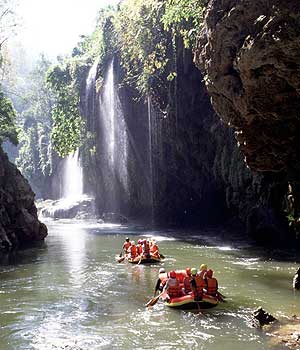
Rafting is fast gaining popularity among the young and young at heart. The mountainous regions of the North are the natural venue for whitewater rafting, especially after the rains from June to October when the rivers swell with floodwater. But first-class rafting is also to be found in the northern reaches of the central region.


TAK
This mountainous province south of Chiang Mai is an increasingly popular adventure destination. The hub of activities is Umphang District on the border with Myanmar which is now accessible via a winding mountain route from Mae Sot, the centre of border trade. The forests of Umphang are the source of many rivers, the most important being the Huai Mae Klong, a popular rafting route with its many rapids and scenic backdrops of jungle. There’s also a rafting route from the breathtaking Thi Lo Su Waterfall which takes three to four hours.


MAE HONG SON
There are five levels of expertise, and all require experienced guides to lead them. Mae Hong Song’sPai River is perhaps the most famous venue, as it smashes its angry path towards Myanmar. A raft trip starts at Ban Nam Kong, 65 km from Pai and continues through virgin forests, waterfalls and 15 sets of rapids, a journey time of about five hours.


CHIANG RAI
One of the oldest rafting destinations in the country, Chiang Rai continues to draw adventure seekers from all over the globe. In Chiang Rai, bamboo rafts and inflatable boats are available for the journey down the Mae Kok, the province’s major artery.


CHIANG MAI
Rafting down the Mae Chaem through Ob Luang George in inflatable boats is available through Mae Sot Travel. Another challenging route is the Mae Tuen in Omkoi District, where the river rushes through virgin forests to end at the Pha Dam Waterfall. No rubber raft is available at the site, so it’s best to book a trip with a tour agen in Chiang Mai.


NAN

Nam Wa stream in Nan is recognised as an ultimate rafting adventure. During rainy season the stream is swollen and rates 3 – 5 on the difficulty scale. Local rafting operators are offering soft adventure tour for rafting buffs wanting to test out their skills. The three – day tour features rafting through a series of rapids, such as Sop Huai Duea and Phi Pa, on specially – designed rubber rafts. Visitors can also use the opportunity to explore the cool jungle setting of Doi Phu Kha and Mae Charim mountains


PRACHINBURI

At Khao Yai National Park, the Kaeng Hin Phoeng in Nadi district of Prachin Buri is a stretch of river noted for its wild beauty. The water is very vigorous During the rainy months (June – October), and some stretches are designated Level 5 , the uppermost limit to whitewater rafting.


KANCHANABURI

On the western border, Kanchanaburi is a popular adventure destination thanks to its mountainous terrain, covered with forests and crisscrossed with a network of rivers. Jungle rafting can be arranged from a mountain pass to the stunning Lawa Cave, a two-hour journey. Bamboo and inflatable rafts are also available for a trip down the Songkalia in Sangkhlaburi.


PHETCHABURI

The headwater of Phetchaburi River, the province’s major artery, lies within Kaeng Krachan National Park. The river offers good rafting; a trip through its rapids and small tributaries takes about six hours.


NAKHON NAYOK

As a rule, canoeing and kayaking is available at the destinations that provide rafting. Nakhon Nayok, a small province to the north of Bangkok, is a new destination for adventure tourism. Its rivers originate in the Khao Yai range and flow down to meet the arterial Bang Pakong River, which empties into Gulf of Thailand.


Nakhon Nayok has several waterfalls, the most popular being Wang Takhrai. Canoeing here is relatively new. The best time to visit is June – October. Starting point for a canoe journey is the stretch of Wang Takhrai canal where it flows through a coffee plantation. The waterway is quite narrow and therefore unsuitable able for larger vessels. The route has on difficult rapids, but its many twists and turns more than make up for it.


Rafting trip on the NAM KEG River at Phitsanulok

The Khek river has its water source in the Phetchabun Mountain Range in Khao Kho county. It flows past Thung salaeng Luang National Park and forms the famous Sri Dit and Kaeng Sopha waterfalls of Phitsanulok. The water course passing Wang Thong county before joining the Nan river at Bang Krathum county is also called the Wang Thong river.


The level of difficulty of the current depends on the volume of water flow. In the rainy season, the river becomes swifter.


Keg River is the good place for rafting as it provides exciting routes for tourists for Ban PakYang, Sapraiwan sub-district, Wang Thong district to Kang Song waterfall which lasts 8 kms. Altogether. You can travel along this route within 3 hours, depending on the water level. You will experience the water speed at level 1-2 and gradually in crease the intensity to level 4-5 in the end. This allows you to practice your skill in rafting along the way.


Some cataracts last hundred meters. Travelling to Keg River is considered convenients as the river is near the road. After you get off a car you can get on a raft promptly, and when you get out of a raft you can get on a car or bus conveniently as well. No need to walk like going to other places.


Rafting on Kaeng Hin Phoeng

This is another stretch of river in Khao Yai National Park noted for its wild beauty. The water is especially challenging in the rainy season months of June to October, and it is a favourite place for whitewater rafting. The passage along this stretch of the river will take three hours or more.


Day 1: Depart Bangkok for a three-hour drive to Prachin Buri via Chachoengsao. After lunch, proceed to Kaeng Hin Phoeng River in Khao Yai National Park, swimming and relaxing at leisure. Then, on to an informal training session with an expert on local conditions to familiarise you with the contours of river, the safety equipment and procedures.


Day 2: After breakfast, a scenic drive into the National Park followed by walking tour through tour through the jungle. Arrive at the starting point of the rafling expedition: A wilder stretch of the river with spectacular rapids designated Level 5 throughout. Conditions for rafting here are not only scenically impressive, but also exciting. The passage along this stretch of the river will take three hours or more. Lunch, beside the river, then two more hours of rafting on fast-moving water before returning to base at the National Park. Drive back to Bangkok along the beautiful Khao Yai – Pack Chong – Muak Lek – Saraburi route.


ACCOMMODATION

• Close to Hin Phoeng rapids, check Kang Hin Poeng Camping Resort, Tel: 0 1842 0161 ; Eco Network, tel: 0 2261 9670 ; WangTa Phap Resort, tel: 0 1663 2656; Sak Supha Resort tel: 0 1454 0076, 0 2249 8093 : and Hin Phoeng Riverside, tel 0 1909 6896.


• At Pong Nam Ron in Chanthaburi, check Soi Dao Highland, tel: 0 3938 7123 – 4 and Ing Dao Resort, tel: 0 3936 0179, 0 3936 0258 – 60


River grading


LEVELS OF DIFFICULTY

Level 1 : Simple, easy rapids.

Level 2 : Simple rapids, but requiring some skill in manoeuvring the raft around obstacles and rocks.

Level 3 : Moderate rapids where rafting becomes exciting. It is necessary to hold on at times to stay in control of the raft.

Level 4 : Difficult rapids with continuous need to manoeuvre and control raft al all times. Very exciting rafting.

Level 5 : This level of whitewater is the uppermost limit to rafting. The river is wild, with a rapid current and difficult rapids, usually very steep.

Level 6 : Extremely difficult rapids, dangerous for rafting.


Preparation


Safety is paramount in whitewater rafting. Life jackets and helmets must be worm at all times. Your guide should explain to you all relevant safety procedures before you go, and check weather reports and the condition of the river. You should be able to swim if you wish to go whitewater rafting.


Age & health


It is important to ensure that you are in good health, and fit enough to enjoy this activity. Children over 12 but under 16 must be accompanied by responsible adults. For children under 12 years or for elderly people, only the Thi Lo Su Waterfall programme in May and June is recommended.


http://www.tourismthailand.org/products/products-sub.aspx?ParentID=135

Wednesday, October 25, 2006


The Massage Message

Here on Samui there’s a myriad of various massages on offer. Some are traditional favourites that you’ll find practiced the world over, whilst others are original fusions of them. And a few are just an attempt to include currently popular buzz words on a spa menu!

Here is some brief background information about the different types of massage that are featured in many of the spas recommended in Samui Health & Spa Guide:

Thai Massage – one of the world’s great massage traditions. A blending of the technique of manipulating the energy which travels throughout your body (meridians in Chinese medicine, sen lines in Thai massage), and the yoga traditions of India. And it’s practiced in different forms reflecting different schools and traditions. Wonderful for the legs and overall balancing of energy, it’s done with the person clothed, without the use of oil. Your energy lines are pressed by the therapist’s thumbs, and then the palms, in a gentle and complete pattern. After your body is loosened up, gentle stretches are done. Different body areas are massaged more than one time, so two hours is not excessively long for a complete treatment. It’s good for tight muscles, low energy levels, and stress. But the stretching involved isn’t good for people with certain back problems, such as herniated disks and fused spinal bones. And if you aren’t flexible, then you may be a little sore the next day. (See ‘The MassageMessage’ article)

Pra Krop – a kind of Thai massage in which herbs are wrapped tightly in cloth, steamed, and the herbal bundles are then touched or pressed to your body. The addition of heat to the technique makes for a more powerfully therapeutic massage. It’s especially good for deep muscle aches and joint pain.

Foot Massage – since the foot is a place rather than a technique, there’s a lot of variety. Foot treatments often include washing and soaking your feet followed by an abrasive scrub to take away any calluses and/or dead skin. The best known foot massage is called reflexology. And, in Thailand, it’s is usually done in the Chinese style. Small tools are often used to rub the sides and tops of your toes, and the massage is very firm. Some people find it too hard and even painful, whilst others love it. This massage was introduced as an official style at the Wat Po massage-teaching temple in Bangkok not so many years ago. Reflexology in Europe and America is different than the Chinese style, where only hands are used to rub your feet. Besides firm pressing, the therapist will pinch the sides of your feet and use their fingertips to work certain areas of your toes, and top and bottom of your feet very thoroughly. This method can also be intense but, without the stick, less people find it painful. (See the ‘Reflexology is Afoot on Samui’ article)

Swedish Massage – called classic massage in Sweden, this massage is the basic oil massage in Europe and North America. Using kneading, gliding, and percussion as the three massage techniques, the classic form has been stretched and altered in innumerable ways. Always using oil, it can be hard or soft, general or specific. Whilst the percussion technique of karate chops on your shoulders (known as ‘hacking’) is always shown in movies and jokes about Swedish massage, the real signature move is a long gliding stroke down your back with the palms of both hands.

Hot Stone Massage – this practice uses warm and smooth volcanic stones as well as the therapist’s hands. Stones are placed on and under your body to let their warmth penetrate deeply. And different stones are held in the therapist’s hands and used to massage the entire body. It’s very relaxing, and people often go into a dreamlike state during the treatment. It’s also believed that the stones absorb negative energy and revitalize the charkas. Hot stone massage, as we know it, came from America about 20 years ago, but some uses of heated stones for massage go back much farther. (See the ‘Getting Stoned on Samui’ article)

Aroma Oil/Aromatherapy Massage – most spas offer an oil massage with essential oils that are usually selected by the customer based either their smell, or their promised effects. Aromatherapy as an esoteric healing practice needs to have a highly-trained practitioner to be really effective, but using it in a more general way it is quite pleasant. The massage part is usually a gentle Swedish massage or some version of a lymphatic-oriented massage. (See the ‘Essential Knowledge’ article)

Cranial Sacral Therapy – is a subtle treatment using very light pressure. It emphasizes the bones of your head and face, but has techniques to release old trauma in other parts of your body too. Developed within the osteopathic tradition, it’s now taught to, and practiced by, a few massage therapists as well as other health professionals. It’s particularly effective for head and facial injuries, dental trauma, balance problems, and for releasing pent-up emotional energy.

These and many other techniques are part of most Samui spa menus. Other types of massage names are generally just descriptions of the hoped-for effects of the massage. Fortunately, most are pleasant at worst, and only a few therapies have any real potential for harm! Still, if ever you have a feeling you shouldn’t let someone continue, it’s best to honour your inner voice.

http://www.siamspaguide.com/massage_message.html

Tuesday, October 24, 2006


Chiang Mai


Experiencing the merging of the past into the present in Chiang Mai where locals are proud of the city's 700-year history. Its rich traditional heritage and unique culture is a perfect foundation for the development of the city. Chiang Mai is one of the few places in Thailand where it is possible to find in the heart of the city centuries-old chedis and temples next to modern convenience stores and boutique hotels. The original city layout still exists as a neat square surrounded by a moat with vestiges of the fortified wall and its four main gates offering prime access to the old town.

For years, tourists have mistaken Chiang Mai as the northern junction and the base from which they can explore other provinces. The phrase "a day in Chiang Mai is enough to see things around" was common. Today, tourists are surprised by the fact that there is always something new to discover Chiang Mai. Intriguing diversity among ethnic tribes coupled with breathtaking scenery makes Chiang Mai one of Asia's most attractive tourist destinations. Two weeks in Chiang Mai may not be long enough for serious travelers.


The old city of Chiang Mai with its fascinating indigenous cultural identity such as diverse dialects, cuisine, architecture, traditional values, festivals, handicrafts and classical dances is a prime location in its own right. In addition, the presence of hill tribes and their wealth of unique cultures enhance Chiang Mai's distinctive diversity.


Chiang Mai is also blessed with pristine natural resources of mountains (dois), waterfalls, and other nature-based tourist attractions. At the same time, Chiang Mai residents are warm, gracious and congenial providing authentic hospitality making visits memorable and meaningful. Moreover, visitors from all walks of life can collect handicrafts of silk, silver and wood produced locally as timeless souvenirs. Chiang Mai is a place where both backpackers and luxury tourists can enjoy themselves to the fullest.


The Past


Chiang Mai literally means new city and has retained the name despite having celebrated its 700th anniversary in 1996. King Meng Rai founded the city as the capital of the Lanna (A Million Rice Fields) Kingdom on Thursday, 12th April 1296 during the same period of time as the establishment of the Sukhothai Kingdom. King Meng Rai the Great conferred with his friends, King Ramkhamhaeng of Sukhothai and King Ngam Muang of Phayao before choosing the site where the capital of the Lanna Kingdom was to be founded.

From then, Chiang Mai not only became the capital and cultural core of the Lanna Kingdom, it was also the centre of Buddhism in northern Thailand. King Meng Rai himself was very religious and founded many of the city's temples, which are still important today.

At the height of its power, the Lanna Kingdom extended its territory far into Burma and Laos, and southwards to Kamphaeng Phet a province above Sukhothai.

The Burmese conquered the Lanna Kingdom in 1556 ending the dynasty founded by King Meng Rai that lasted over 250 years. As Burma had occupied Chiang Mai for nearly 200 years, Burmese architectural influences are visible in many temples. At the end of the 18th century, King Taksin the Great regrouped the Thais in the south and finally drove the Burmese out with the help of King Kawila of Lampang thereby regaining Thai independence from Burma. Chiang Mai was then governed by a succession of princes who ruled the north as a Siamese protectorate under the Chakri dynasty. In the late 19th century, King Rama V appointed a high commissioner in Chiang Mai and it was only in 1939 that Chiang Mai finally came under the direct control of the central government in Bangkok the same time the country was renamed Thailand.

In the past, Chiang Mai was only accessible by river and elephants. More convenient access was achieved only when the railway line was completed in the late 1920's. Moreover, the first motor vehicle driven directly from Bangkok arrived in Chiang Mai in 1932. Such isolation was more favorable to Chiang Mai as it helped to nurture and preserve the unique Lanna culture.
When we look at Chiang Mai today, it is the economic, cultural and communications hub of northern Thailand complete with excellent infrastructure, good roads, by passes and road tunnels, and reliable communications infrastructure.


The Setting


Chiang Mai, with an altitude of approximately 310 meters above sea level, is situated approximately 700 kilometers from Bangkok on the Mae Ping River basin. Surrounded by high mountain ranges, the city covers an area of approximately 20,107 square kilometers and is the country's second largest province. Chiang Mai borders Myanmar on the north, Lamphun and Tak Provinces on the south, Chiang Rai, Lampang and Lamphun Provinces on the east and Mae Hong Son Province on the west. The terrain is mainly comprised of jungles and mountains, which are home to the hill tribes. In addition, wildlife and exotic flora may be found in the national parks.

Most of Chiang Mai's mountains are oriented from north to south. Together they create a multitude of streams and tributaries including Mae Chaem, Mae Ngat and Mae Klang. One of Chiang Mai's distinctive features is Doi Inthanon, Thailands highest peak, which is 2,575 meters above sea level. In addition, the province boasts flat, fertile valleys, which spread along the banks of the largest and most important river in Chiang Mai Mae Nam Ping (Ping River) which originates from the Chiang Dao mountain range.

http://www.tourismthailand.org/destinationguide/list.aspx?provinceid=38

Thursday, October 19, 2006


About Thailand
Full Country Name: Thailand (Prathet Thai, meaning "land of the free")


Capital: Bangkok (Krung Thep, meaning "city of angels")


Geography:

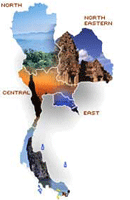
The kingdom of Thailand lies in the heart of Southeast Asia, making it a natural gateway to Indochina, Myanmar and Southern China. Its shape and geography divide into four natural regions : the mountains and forests of the North; the vast rice fields of the Central Plains; the semi-arid farm lands of the Northeast plateau; and the tropical islands and long coastline of the peninsula South.

The country comprises 76 provinces that are further divided into districts, sub-districts and villages. Bangkok is the capital city and centre of political, commercial, industrial and cultural activities. It is also the seat of Thailand's revered Royal Family, with His Majesty the King recognised as Head of State, Head of the Armed Forces, Upholder of the Buddhist religion and Upholder of all religions.

Thailand is a constitutional monarchy with His Majesty King Bhumibol Adulyadej, or King Rama IX, the ninth king of the Chakri Dynasty, the present king. The King has reigned for more than half a century, making him the longest reigning Thai monarch. Thailand embraces a rich diversity of cultures and traditions. With its proud history, tropical climate and renowned hospitality, the Kingdom is a never-ending source of fascination and pleasure for international visitors.


Neighboring Countries:
1) Myanmar - west and north,
2) Lao P.D.R. - north and northeast,
3) Cambodia - southeast and
4) Malaysia - south.


Area: 513,115 sq. km.


Topography:

Thailand is divided into 4 natural regions:

The mountainous North, with its profusion of multi-coloured orchids, fascinating native handicrafts and winter temperatures are sufficiently cool to permit cultivation of temperate fruits such as strawberries and peaches;

The high Northeast Plateau, which still jealously guards its many archaeological and anthropological mysteries;

The Central Plain, one of the world's most fertile rice and fruit-growing areas with colourful traditional culture and way of life as well as the sandy beaches of the East Coast and vibrant cosmopolitan Bangkok;

The peninsular South where the unspoiled beaches and idyllic islands complement economically vital tin mining, rubber cultivation and fishing.


Population:

Thais are well-known for their friendliness and hospitality. A large majority of over 62 million citizens of Thailand are ethic Thai, along with strong communities whose ethnic origins lie in China, India and elsewhere. About 7 million people reside in the capital city of Bangkok.


People:

Thai (80%), Chinese (10%), Malay (3%), and the rest are minorities (Mons, Khmers, hill tribes) Ethnic Thais form the majority, though the area has historically been a migratory crossroads, and has thus produced a degree of ethnic diversity. Integration is such, however, that culturally and socially there is enormous unity.


Language:

Spoken and written Thai is largely incomprehensible to the casual visitor. However, English is widely understood, particularly in Bangkok where it is almost the major commercial language. English and some European Languages are spoken in most hotels, shops and restaurants in major tourist destinations, and Thai-English road and street signs are found nationwide.


Religion: Buddhism (95%), Muslim (4%), others (1%)


Government:

Thailand has had a constitutional monarchy since 1932. Parliament is composed of 2 houses, The House of Representatives and the Senate. Both representatives and senators are elected by the people. A prime minister elected from among the representatives leads the government. The country is divided into 76 provinces. The Bangkok Metropolitan Administration comes under an elected governor. Appointed provincial governors administer the other 75 provinces (Changwat), which are divided into districts (Amphoe), sub-districts (Tambon) and villages (Mu Ban).


Head of State:

H.M. King Bhumibol Adulyadej (Rama IX of the Chakri Dynasty)


Prime Minister: Thaksin Shinawatra


Administration:

76 provinces, each subdivided into amphoe (district), tambon (sub-district) and muban (village)


National Flag:

The red, white, and blue stripes symbolize the nation, Buddhism, and the monarchy, respectively.


Time:

The time in Thailand is seven hours ahead of Greenwich Mean Time (+7 hours GMT).


Climate:

Thailand enjoys a tropical climate with three distinct seasons-hot and dry from February to May (average temperature 34 degrees Celsius and 75% humidity); rainy with plenty of sunshine from June to October (average day temperature 29 degrees Celsius and 87% humidity); and cool from November to January (temperatures range from 32 degrees Celsius to below 20 degrees Celsius with a drop in humidity).

Much lower temperatures are experienced in the North and Northeast during nighttime. The South has a tropical rainforest climate with temperatures averaging 28 degrees Celsius almost all year round.


Electricity:

The electric current is 220 volt AC (50 cycles) throughout the country. Many different types of plugs and sockets are in use. Travellers with electric shavers, hair dryers, tape recorders and other appliances should carry a plug adapter kit. The better hotels will make available 110-volt transformers.


Tap water:

Tap water is clean but drinking from it directly should be avoided. Bottled water is recommended


Clothing :

Light, cool clothes are sensible and a jacket is needed for formal meetings and dining in top restaurants. Shorts (except knee length walking shorts), sleeveless shirts, tank tops and other beach-style attire are considered inappropriate dress when not actually at the beach or in a resort area.


Weights & Measures :

The metric system is used throughout Thailand. Numerals on vehicle speed ohmmeters, highway markers and speed limits all indicate kilometres.


Business hours :

Most commercial concerns in Bangkok operate on a five-day week, usually from 8 am to 5 pm. Many stores open seven days a week from 10 am to 10 pm. Government offices are generally open between 8.30 am and 4.30 pm with a noon to 1 pm lunch break, Monday to Friday except on public holidays. Banks are open Mondays to Fridays from 9.30 am to 3.30 pm except on public holidays.


Postal Services :

Thailand's mail service is reliable and efficient. Major hotels provide basic postal services on their premises. Provincial post offices are usually open from 8.00 a.m. to 4.30 p.m.

International Roaming Mobile Phone : A Subscriber Identity Module Card (SIM Card) is now available for Thai and foreign customers who are travelling around for work. The SIM Card must be used in conjunction with a Digital GSM mobile phone within the 900-MHz range or a Digital PCN mobile phone within the 1800-MHz range.


Fax and E-Mail :

All of Thailand's leading hotels offer facsimile (fax) and e-mail services. Numerous private businesses offer such facilities, most often in conjunction with translation services.


Internet Services :

Thailand has been expanding its information service for residents and tourists alike through the Internet system. Services are now available at Thailand's leading hotels and at the many " Cyber-Cafes " that are cropping up in all major tourist destinations.


Telephone Services :

At present, all telephone numbers (for local calls and long distance calls within the country) have nine digits.

For Bangkok calls, 02 is added to the existing numbers i.e. 0 2694 1222.


For provincial calls, an area code is added to the existing numbers. For example, area code for Chiang Mai is 053 = 0 5324 8604; area code for Phuket is 076 = 0 7621 1036.
For mobile phones, 01 or 09 is added to the existing numbers.
The new system has no effect on international phone calls.
The international dialing code for Thailand is 66.
When making international calls to Thailand, add 66 and omit the leading 0.


When making international calls from Thailand, first dial 001+country code+area code+telephone number


If calling Laos or Malaysia, there is a special code which is charged at a semi-domestic rate.
When calling Laos, first dial 007+856+area code+telephone number
When calling Malaysia, first dial 09+06+area code+telephone number
Direct assistance: 1133 (local), 100 (international)


Emergency Telephone Numbers

Central Emergency (Police, Ambulance, Fire) : 191

Highway Patrol : 1193

Crime Suppression : 195 or (662) 513 3844

Tourist Police (English, French and German spoken) : 1155

Tourism Authority of Thailand (TAT) Call Centre : 1672

Immigration Bureau : (662) 287 3101-10